Service Award Programs
How to Design Recognition That Drives Retention
Contributing Experts:
Alex Allion, Director of Symbolic Recognition and Partnerships
Lars Knudsen, Chief Sales Officer


Manager-Driven Recognition
Somewhere in your organization, an employee is about to reach a milestone. Ten years. Maybe 25. Whether you mark that moment in a consequential way or let it pass with a generic gift and an automated email, your choice shows that person what their tenure is worth. They’ll draw a conclusion one way or the other.
Your service award program is the system that determines which message your people receive. Built well, it’s a direct retention lever. Make it work together with your digital platform, and you add concreteness and even greater depth to your employee recognition program.
A service award program impacts behavior when the recognition moment feels earned. That requires awards that are symbolic, lasting, and personal. Every aspect of your program, from milestone cadence to ROI, should build on this foundational truth.
Terryberry has been designing employee engagement programs since 1918, and our advice on designing cost-effective, retention-driving service award programs comes from what our clients, and their own employees, share with us about what really works.
What Is a Service Award Program?
A service award program is a structured way for an organization to recognize employees at defined tenure milestones, such as 1, 5, 10, or 25 years of service.
The strongest programs pair a personalized, lasting award with intentional presentation, making a date on the calendar a moment that reinforces why an employee chooses to stay with the organization.
That structure is what separates a service award program from a one-off anniversary gift. A gift is a transaction. A program is a system, with four working parts:
- A defined milestone cadence
- A deliberate choice of award at each level
- A presentation ritual that gives the moment weight
- A way to administer and measure at scale
A service award program is one pillar of a broader employee engagement program.
Everyday and peer recognition help ensure frequency and equity: the small, regular acknowledgments that keep people engaged week to week. Service awards handle the milestones that define a career. A complete corporate recognition program runs both, with each doing what it does best. A common mistake is treating one as a substitute for the other.
Why Do Service Award Programs Drive Employee Retention?
Recognition is one of the few low-cost levers proven to change whether people stay. The effect is greatest when the recognition feels personal and earned, not routine.
The research is consistent, showing that employees who received high-quality recognition were 45% less likely to have left their job two years later.1 The reason employees stay isn’t the item given; it’s what that object signals.
A service award answers a question employees rarely ask out loud: does this organization actually see me and value what I bring? A milestone marked with a personalized award, presented by a leader who names the person’s specific contribution, shows them you do.
Recognition is where belonging can be built or broken. When it feels earned, it shows an employee they’re part of something that values their shared history. That sense of belonging, not the unit cost of the award, is what surfaces later in retention data.
“It’s not about how much you’re spending. It’s about the fact that it seems thoughtful.”
Standard Service Award Milestones
Most service award programs recognize employees at the following tenure milestones:
| Milestone | What It Signals |
|---|---|
| 1 Year | The first anniversary (or even earlier in high-turnover industries), increasingly important because most turnover happens early |
| 3 Years | Confirms the employee is established and invested |
| 5 Years | The first major milestone in most programs |
| 10 Years | A signal of real loyalty; often the point where award quality should step up |
| 15 and 20 Years | Sustained commitment that deserves visible, premium recognition |
| 25 Years | A career-defining milestone, typically the program’s marquee award |
| 30, 35, 40+ Years | Legacy recognition, often customized to the individual |
Two adjustments separate a modern program from one based on old-school thinking:
First, recognize early tenure. Voluntary turnover concentrates in the first one to three years, so recognition at the one-year and three-year marks protects the investment you’ve already made in hiring and training. Some organizations in high-turnover industries even choose to celebrate a 6-month employee milestone. Waiting until year five to say anything is waiting too long.
Second, milestones are about more than tenure. The same program logic applies to safety milestones in manufacturing, construction, and industrial settings, and to performance milestones such as President’s Club for sales teams. The principle holds across all of them: the award should scale in significance to match the achievement. For a closer look at how to match awards to specific milestones—including budget considerations and award formats by tenure—see Years of Service Awards: Tips, Tools & Program Ideas.
How to Design a Service Award Program That Gets Results
A service award program works when it’s designed around the moments you already recognize and the people you most need to reach. These six decisions separate programs that impact behavior from programs that don’t:
Confirm Your Organization Is Ready
Launching before you’re ready can do more harm than waiting. A generic award in a plain box, with no context or ceremony, signals that the milestone, and the employee, didn’t merit much thought. Before designing anything, confirm four things:
- Your values are defined and employees can name them
- A budget exists for quality, not placeholder items
- At least one senior leader will personally present awards
- Recognition criteria connect to specific behaviors, milestones, or KPIs
Define What You’re Recognizing, and Why
You can’t recognize people for values they can’t articulate. When Terryberry built a structured program for Amteck, employees’ ability to articulate core values rose 65% within three months—not because the awards taught the values, but because the program created recurring, visible moments built around them.
Budget for Quality, Not Placeholders
Budgeting for quality awards is usually a reallocation decision, not new spend. Bonuses get taxed and disappear. A well-designed award is received in full, worn or displayed prominently, and often kept for years or decades, and even passed down through generations. Spend where the moment matters most.
Secure Genuine Leadership Buy-In
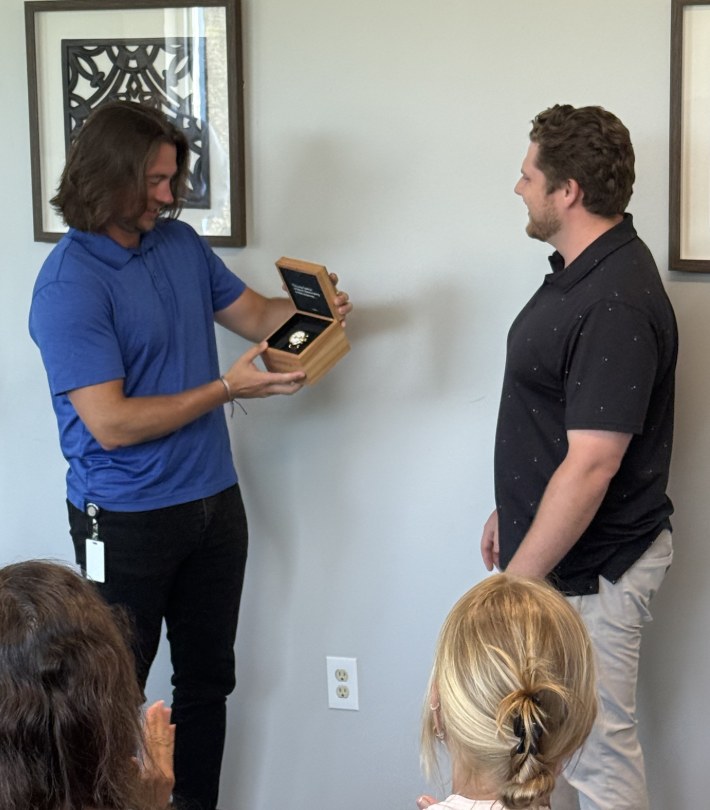
The single biggest variable in a program’s impact isn’t the award. It’s how leaders show up for the moment. An award presented at a team meeting, with a leader connecting the recipient to the values it represents, is a fundamentally different experience from the same award arriving in a box, unannounced.
Match the Award to Your Workforce
The right award for a nurse marking 15 years looks nothing like the right award for a sales rep who just qualified for President’s Club. Rings, jewelry, watches, lapel pins, and other wearables work because they’re visible, personal, and upgradable over time. Lapel pins solve a constraint in uniform-based industries like healthcare: recognition that fits a badge or scrubs and scales affordably across large frontline populations. Perpetual desk awards that grow with add-ons suit core-values programs.
Organizations with mixed workforces increasingly offer a choice of awards, signaling equity across all teams, including deskless employees.
Design for Your Brand, Not a Catalog
In our experience, the most common reason organizations switch award vendors is that the awards felt generic, and employees noticed. Your service awards should look and feel like your organization: your brand, your language, your values. For the milestones that matter most, that can mean a fully bespoke program designed from hand-sketched concepts.
How to Choose the Right Award For the Occasion
For everyday rewards, cash, points, and gift cards are efficient and welcome. When it comes to milestone moments, it’s important to choose an award that’s going to last.
A milestone award should be symbolic, personalized, and tangible, because the goal is enduring meaning. The table below compares the common formats on the dimensions that decide whether recognition sticks.
| Dimension | Cash / Bonus | Symbolic Award |
|---|---|---|
| Will it last beyond the moment? | No; spent quickly | Yes; kept for years |
| Does it feel personal? | No | Yes; designed for them |
| Is it visible to peers? | No | Yes; worn or displayed |
| Does it carry company values? | No | Yes, by design |
| Could it be tax-advantaged?* | No | Yes, if structured to IRS rules* |
| Best use | Spot/everyday rewards | Milestones & earned moments |
*The potential tax advantage is often overlooked. Under IRS rules (IRC §274(j)), a length-of-service or safety award of tangible personal property, given as part of a meaningful presentation, can be excluded from an employee’s income up to $1,600 under a qualified plan. Cash, gift cards, and gift certificates do not qualify. So a symbolic award can deliver more take-home value than a cash bonus of the same cost. Confirm specifics with your tax advisor.
This is the earned, not bought distinction in practice. Your top performers can buy almost anything online. What they can’t buy is an award that carries your company’s values, their name, and the weight of an achievement only they earned.

How You Present Service Awards Matters for Relevance and Impact
Presentation affects employee perceptions as much as the award itself. The same piece can land completely differently depending on who presents it, where, in front of whom, and what they say. A leader naming a specific contribution in front of peers has the power to transform an object into a moment with weight and lasting memorability. The same award simply left on a desk or at a locker says the company went through the motions.
Here’s a simple test for program design: if an employee’s first thought is “everybody gets this,” you have a problem. Recognition everyone receives at every interval, regardless of contribution, degrades fast. Certificates end up in the recycling bin. Earned recognition, presented the right way, creates staying power.
From the Field
After a highly matrixed, multi-entity provider of testing, inspection, and certification switched its program to Terryberry, employees began sharing photos of their milestone awards on social media, displaying them at their workstations, and keeping them visible in the background on video calls. That had never happened with their prior vendor’s catalog items.
The difference wasn’t the awards budget. It was how employees felt.
85%
retention among employees with 10+ years of service — Amteck
70%
less program administration time — Amteck
2×
qualifying sales reps after a ring-based President’s Club — La-Z-Boy
How Do You Measure the ROI of a Service Award Program?
Your service award program’s return on investment can be measured in retention improvements. Replacing an employee costs between one-half and two times their annual salary.2 A program that cuts voluntary turnover even modestly pays for itself many times over.
Run the numbers conservatively. If a program reduces voluntary turnover by just 10%, it clears its own cost across most mid-sized workforces.
The proof shows up in client data: after implementing a structured Terryberry program, Amteck reached an 85% retention rate among employees with 10 or more years of service and cut program administration time by 70%. On the performance side, when La-Z-Boy launched a ring-based President’s Club program, the number of qualifying sales reps doubled.
To monitor and defend your own program internally, the smart move is to track a focused set of measures, rather than activity for its own sake:
- Retention rate by tenure cohort, before and after launch
- Voluntary turnover among recognized vs. not-yet-recognized employees
- Participation and redemption rates across desk and frontline populations
- eNPS and sentiment movement tied to recognition
- Manager adoption: how many leaders present awards in person
Build a Program Your Employees Won’t Forget
Get the Service Award Program Brochure: formats, milestone structures, and examples to help you design or rebuild your program.

What Does a Great Service Award Program Look Like in Practice?
Amteck, a family-owned construction company with a large field workforce, had recognition that was inconsistent and hard to administer. After moving to a structured Terryberry service award program, the change showed up in the numbers—and in the workforce.
Within three months, employees’ ability to articulate the company’s core values rose 65%, because the program created recurring, visible moments built around those values. Administration time dropped 70%, freeing a lean HR team. And among employees with 10 or more years of service, retention reached 85%. The awards helped reach field employees and strengthen their connection to the organization.
“The reactions were incredible. People stood straighter, smiled wider, and often became emotional. It surprised me just how much of an impact it had.”
Terryberry Symbolic Awards: Recognition Designed to Last
A symbolic award program isn’t a standalone product. It’s the physical recognition layer that makes a full program credible, complete, and something employees remember and appreciate.
Terryberry is the only engagement partner that combines an engagement platform with in-house symbolic award design and manufacturing, crafted in our Grand Rapids, Michigan facilities since 1918. That means the milestone awards, service programs, President’s Club pieces, and safety recognition you design with us are made by the same company that helps you run the broader program.
For organizations with frontline, deskless, and distributed teams, this matters. A symbolic award helps connect harder-to-reach employees in unique ways: it goes home, sits on a shelf or a locker, rides in a toolbox, or is proudly worn. It reaches everyone, regardless of role or system access. Our Awards Lab partners with clients to build fully bespoke programs from the ground up when the moment calls for something one-of-a-kind.
By the Numbers
44,000+
global clients
100+
years in employee engagement and recognition
1,000,000+
recognition moments annually
150+
countries served
Symbolic awards and digital recognition don’t compete. Each complements the other, because they’re built for different moments:
- A platform delivers frequency and visibility across the organization.
- A symbolic award delivers depth and permanence.
The strongest programs use both, with each doing what it does best. The platform keeps recognition flowing; symbolic marks the moments that define a career.
Ready to Design Your Program?
Talk to a Terryberry symbolic awards consultant about what a program built for your size, industry, workforce, and budget could look like.
Frequently Asked Questions
It’s Time to Rethink Your Service Awards Program
A service award program built to show employees their contributions are seen and valued, with awards that are earned, lasting, and personal, and presented by leaders who mean it, is one of the most durable retention investments an organization can make to build the kind of loyalty that has bottom-line impact.
See What a Program Designed for Your Workforce Could Look Like
1 Workhuman & Gallup, Recognition prevents 45% of voluntary turnover (2024)
2 Gallup, Cost of replacing an employee (0.5–2x salary; $1T turnover)