December 11, 2025

Continuous employee listening turns everyday signals into decisive action instead of a once‑a‑year checkbox. You can discover problems early, guide targeted action, and prove the impact of the initiatives you take.
This guide shows HR leaders how to design a listening program that aligns with business goals, scales without draining capacity, and consistently closes the loop so employees see their input turned into outcomes.
You’ll get practical guidance on what to measure, how often to listen, and ways to maximize participation. We’ll also cover methods to analyze, prioritize, and act on findings to improve retention, engagement, and well-being.
Read on for a step‑by‑step playbook that shows you how to build a scalable listening program and put feedback to work. We cover how to:
- Choose surveys that align with your strategic objectives, set the right cadence, and the best practices for follow-ups.
- Maximize participation and data quality with anonymity, accessibility, and communication best practices.
- Analyze survey results, investigate root causes, uncover trends specific to different groups, and determine the highest‑impact actions.
- Define success and measure impact, so you can prove ROI and make a clear business case to leadership.
We’ll also take you over how to run a continuous employee listening program on autopilot—from designing surveys to processing results and taking action—using a dedicated employee listening and engagement platform.
What Will You Measure? Aligning Business Objectives With Your Listening Program
When you’re designing a continuous employee listening program, the first step is to define your strategic objectives. Are you looking to boost retention, reduce burnout, or collect feedback to improve policies? Maybe you’ve got all these goals and more.
The objectives you set guide the major decisions around setting up a listening program—who to survey, when, how often, the actions to take, and the KPIs to measure. For example, if your goal is to:
- Predict churn and reduce it. You’d frequently run eNPS surveys to keep track of churn risks and use employee engagement surveys (e.g., biannually) to understand why these groups are prone to turnover.
- Understand the root causes of low employee engagement. You’d first use a baseline survey to get an overall picture of employee engagement, and then follow up with surveys to investigate the gaps you uncover—such as engagement drill-down, employee satisfaction, stay, and exit surveys.
- Help new hires settle in. Integration and new hire surveys can help you assess recruiting and onboarding experiences. Typically, the first survey is sent during the first week to capture feedback on the recruiting process. Additional check-ins at 30, 60, and 90 days help track progress with onboarding and integration. By the one-year mark, engagement surveys can provide valuable insights into how well this group has connected with your company's culture.
If you don’t yet have well-defined goals, you can start broad and update your strategy based on insights from the initial round of surveys.
For example, engagement baseline, employee satisfaction, and regular pulse surveys can uncover gaps and problem areas. Launching an “anonymous feedback box” in the form of short surveys with open-ended questions can help cover your blind spots.
The companies that we work with typically have some combination of the following goals:
- Uncovering churn risk groups—e.g., maybe employees in a specific role with three years of tenure are more likely to leave.
- Measuring and quantifying their culture’s positive and negative impact on employee engagement—so they know what they’re doing well and where they need to improve.
- Automate survey processing—so they can take action and close the loop quickly.
- Identifying trends specific to different cohorts to inform next actions—by analyzing responses across various groups (e.g., departments, facilities, seniority levels, people with similar tenure) to find common themes.
Most organizations already have a sense of their problem areas and potential causes—for example, they may recognize that new-hire turnover is an issue and suspect onboarding is to blame.
However, the real challenge is that employees are motivated by different things and don’t all experience company culture in the same way. Sentiments can vary widely across generations, departments, professions, or a mix of these factors.
Industry research highlights another gap (one that we’ve seen firsthand across various industries): HR leaders’ assumptions about what drives retention often don’t match what employees actually value.
For example, employees may value strong relationships with colleagues far more than training and development, while HR leaders focus primarily on development programs.
Overcoming these gaps is key to building listening programs that truly make an impact—employers need to understand which factors matter most to their people, and further investigate the different sentiments and motivations across groups.
We developed Terryberry’s science-backed culture model and engagement surveys to help employers do just that. Designed by three independent PhD researchers, the culture model lets companies accurately quantify their culture’s impact (both positive and negative) on employee engagement across groups—and gain an accurate picture of employee turnover.
Our culture model uses six engagement indicators—belonging, leadership, purpose, well-being, empowerment, and equity to measure and quantify engagement:
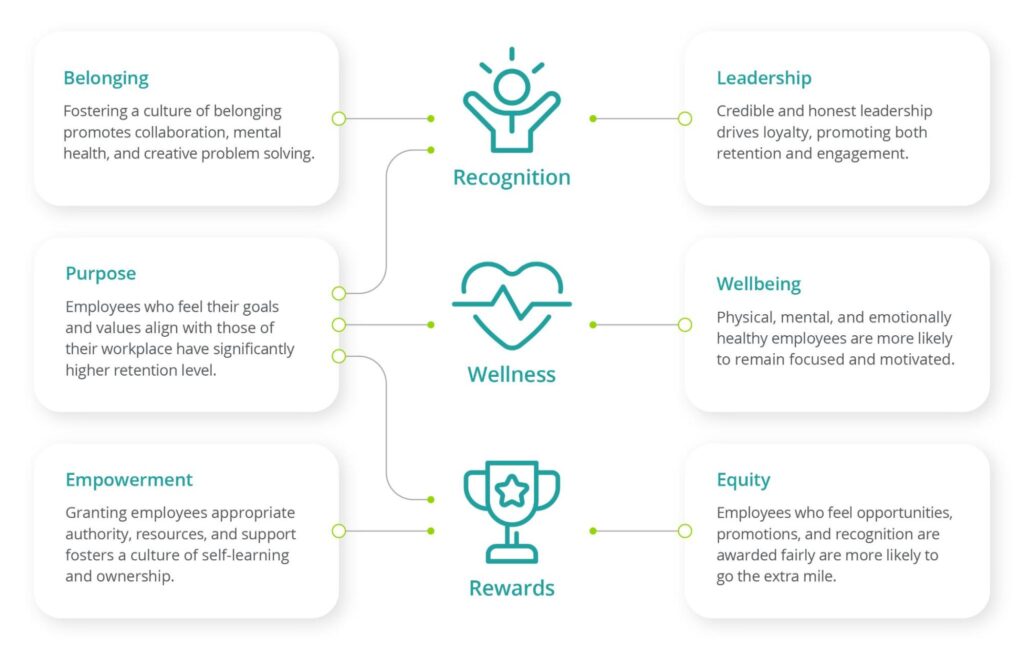
Each indicator tells a story about how your culture impacts a specific aspect of engagement. For example:
- Engaged employees feel a strong sense of empowerment when they have the tools they need to excel in their work.
- People feel a strong sense of purpose when they see how their work and values align with company goals.
Our engagement baseline survey (backed by industrial-organizational (I/O) psychologists—specialists that apply psychological principles to the workplace) uses the Likert Scale to measure and quantify these six key indicators, giving you a well-rounded view of engagement across your organization.
After running the baseline survey, you’ll have a set of six Likert scores—which can be positive or negative—corresponding to each indicator. A score of +30 in leadership would indicate strong manager-employee relationships, whereas -5 in belonging signals people don’t feel strongly connected to your culture.
The engagement indicator scores double as KPIs for your engagement strategy—with high scores demonstrating success and low scores guiding the objectives for engagement initiatives and programs. These insights help you lay the groundwork for your employee listening strategy by revealing gaps to address, groups to focus on, and strengths to build upon.
You can further combine insights from the baseline survey with eNPS to understand how each indicator impacts retention across different groups—maybe “belonging” and “purpose” contribute more to retention in some departments than others. Over time, you can track the relationship between eNPS and these indicator scores to see if they improve together.
Does Your Listening Program Accurately Represent Everyone? Maximizing Participation and Response Quality
Asking the right questions at the right time is important—but it’s only part of the equation. To truly capture an accurate picture of your workforce’s sentiments, you also need strong participation numbers and accurate responses.
The good news is that you don’t need to reinvent the wheel here. Over decades of working in employee engagement, we’ve identified a set of core best practices that consistently maximize participation and improve data quality across listening programs.
Here’s how you can set yours up for success:
✅ Clearly announce the survey with advance notice—and explain why you’re running the survey and what you plan to do with the feedback. You can create templates to use each time you send out surveys.
✅ Send reminders to non-respondents—at strategic intervals during the survey window. Be sure to space these reminders out to avoid overwhelming people.
✅ Make your surveys available on the right channels—like email and mobile—and account for your workforce’s unique needs, whether they’re remote or some lack corporate email addresses. We’ve even delivered surveys offline (paper-based) and set them up on kiosks to make sure everyone can participate.
✅ Emphasize confidentiality and anonymity—to ensure people respond honestly. This is crucial for obtaining the most accurate data.
🚫 Don’t provide incentives if you’re seeking scientific, quantifiable information and qualitative feedback—they can introduce bias and skew results by motivating participation for the wrong reasons.
✅ Close the loop—after collecting feedback and analyzing responses, commit to taking action and keep respondents informed about the steps you’ve taken based on their feedback. This shows them that you value their input and motivates people to continue participating in your program.
✅ Combine insights from different sources—not just surveys. Get 1:1 feedback, talk to people’s managers, and pull insights from engagement programs (such as recognition) to add context to your findings.
✅ Add an anonymous feedback box—and use open-ended survey questions to cover any blind spots.
✅ Give everyone ample time to participate—we recommend keeping surveys open for around two weeks.
✅ Use the right technology—to simplify admin work, automate survey processing, and provide comprehensive analytics.
✅ Analyze results by cohort—filter and group results by demographics (department, location, tenure, etc.) to uncover trends and shared sentiments.
How Will You Take Action? Closing the Loop On Employee Feedback
Making employees feel heard is about more than just collecting their feedback; you need to evaluate it, investigate the root causes, take relevant actions, and communicate to employees what steps you’ve taken.
This process—known as closing the loop—is at the heart of every successful employee listening program. The types of actions you take depend on the gaps revealed by analyzing survey responses. For example, you might update policies, launch manager training initiatives, rebalance workloads, or develop tailored employee engagement programs.
In many cases, closing the loop involves launching dedicated engagement programs that actively support your workforce, strengthen culture, and tackle issues as they surface. Companies that prioritize retention and engagement make these programs a core part of their strategy. Alongside continuous listening, the most common engagement programs include:
❇️ Employee recognition and rewards. These versatile programs can be tailored to various strategic objectives, such as instilling company core values, celebrating loyalty, promoting safety protocols, and driving performance goals.
Recognition initiatives correlate with 15% higher eNPS, and employees who receive recognition and feel consistently appreciated are 45% less likely to leave the organization after two years.
❇️ Employee well-being programs. Supporting employees’ physical and mental well-being improves productivity, boosts morale, and increases retention. Wellness programs range from building healthy habits (e.g., staying active or hydrated) through wellness challenges to expert-led trainings on work-life balance and stress management, to one-on-one counseling and personalized wellness plans.
❇️ Learning and development programs. Make sure employees have the tools and support they need to excel in their roles with tailored training programs. If you find employees scoring low in empowerment—maybe it’s a common theme among frontline managers—these programs may be necessary.
❇️ Performance management programs. Ensuring people see a future at your company keeps them motivated in their day-to-day and boosts retention. Performance programs develop personalized career pathways that align each individual’s ambitions with your organization’s vision and goals, increasing people’s feelings of equity.
If you plan to pursue several courses of action, it’s best to take a step back and first develop a criterion for prioritizing them. Here, it’s essential to consider if you’ll need to secure budgets and executive buy-in.
- If you do, then it’s usually best to start with some quick wins—actions that are feasible and promise some impact—to first build confidence in your initiatives. For example, launching a recognition program focused on new hires to decrease turnover, or starting a hydration and sleep challenge to improve well-being. As your initiatives show results, you can build confidence internally and advocate for more programs.
- If leadership’s already bought in, you might prioritize initiatives that promise the most impact—even if they’re resource-intensive. For example, fast-growing companies that feel employees are losing their connection to core values (impacting retention) may prioritize organization-wide recognition programs. If you start with organization-wide programs, use employee listening to uncover gaps over time—and address them with smaller, tailored initiatives.
How Will You Measure Success?
After collecting feedback and taking action, the next step is to measure the impact of the initiatives you’ve taken to uncover gaps and build a business case for leadership. While you can track broad HR metrics, such as voluntary turnover rate, employee satisfaction, and absenteeism, doing so has limitations.
🚫 These metrics may take time to improve significantly—so they don’t reveal the current successes of your program.
🚫 They aren’t independently attributable to the initiatives you’ve taken—making it difficult to prove impact. Retention might have increased over the past year, but can you prove its connection to your program?
For these reasons, it’s essential to go beyond broad HR metrics and track:
- Changes in employee sentiments using follow-up surveys—follow up with drill-down engagement and eNPS surveys after some time to quantify the impact of your initiatives. Look for changes in engagement indicator scores and any corresponding impact on eNPS.
- Direct feedback about the changes you’ve made—run surveys asking about the initiatives you’ve taken or the programs you’ve launched.
- Participation data of the programs (e.g., recognition) that you’ve launched to address gaps—including the number of participants and which employees and managers have participated the most and least. When your programs are tailored to specific objectives—such as recognizing people for demonstrating core values—then participation metrics show that they’re driving these goals forward.
Combining these data sets can help you attribute initiatives to success metrics and prove the impact of your programs. For example, you can correlate improvements in engagement indicators and eNPS with program participation and link your findings to a shift in voluntary turnover rates.
Employee Listening Tools: The Key to Scaling Your Listening Program
While you can use basic form tools or makeshift solutions for running surveys, continuous listening programs need a dedicated platform to be effective. Relying on manual processes or clunky systems only slows things down—delaying survey results, stalling action, and ultimately creating a frustrating experience for both HR and employees.
The best systems let you manage your entire listening program from end-to-end, including:
- Designing surveys (or selecting ready-made ones) and delivering them across your chosen channels—and then aggregating all the responses in one place.
- Tracking and processing results—to save HR valuable time and help them close the loop quickly.
- Ensure true anonymity—while allowing you to send follow-up surveys to the same groups and track their sentiments over time.
- Cohort analysis and benchmarking—so you can uncover trends, root causes, and actionable insights.
Up next, we’ll take you over our own employee listening and engagement platform that lets you do all this and more.
Scale Your Continuous Employee Listening Program with Terryberry
Terryberry’s employee engagement software lets you launch continuous employee listening programs, take action, and close the loop in a single, integrated platform. Our system combines employee listening, recognition, rewards, and wellness tools to provide unified data across all your programs.
Combining insights from employee listening, recognition and wellness programs creates a powerful feedback loop:
Collect survey insights → Take action → Feed program data (recognition, wellness) back to employee listening → Follow-up with more surveys → Continuously update your strategy
This integration creates a self-reinforcing system where:
- Survey data identifies engagement gaps
- Engagement programs address those gaps
- Program participation data enriches future survey analysis
- Each survey cycle measures the impact of previous actions
- The cycle repeats, driving continuous cultural improvement
Here’s how to build this system with Terryberry’s suite of engagement tools:
Measure What Matters with Our Suite of Employee Listening Tools
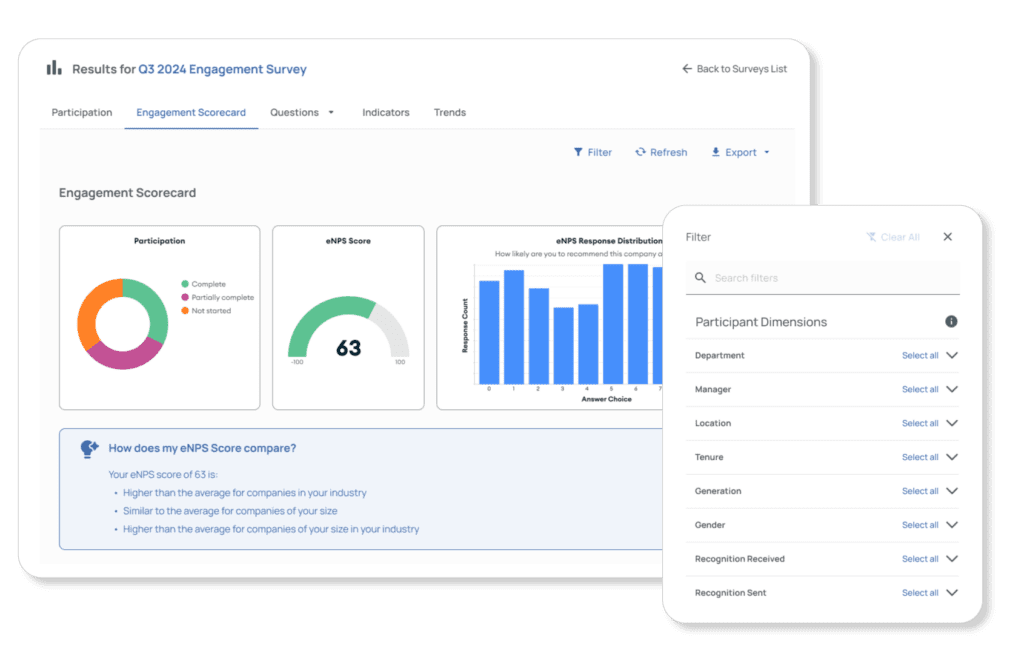
Terryberry’s employee listening tool—Be Heard—offers everything you need to collect feedback, track employee sentiments, investigate root causes, and measure impact. Be Heard features:
✅ Extensive survey templates library. With science-backed templates for baseline, pulse, drill-down, new hire, exit, stay, ad hoc surveys, and more.
✅ An AI-powered survey builder. Quickly generate custom surveys based on your objectives by adapting questions from Terryberry’s survey library to your needs.
✅ Automations to reduce HR burden. Be Heard consolidates responses across all channels, automatically processes the results, supports automated scheduling and reminders, and enables you to send test surveys to internal users before launch.
✅ Anonymity protection. We impose a 6-response minimum threshold (if fewer than six people in a group responded, you can’t view these scores directly, but the data is included in aggregate scores). Our third-party encryption ensures individual responses can’t be traced.
✅ Multi-channel survey delivery options. Be Heard supports survey delivery via desktop, mobile app, QR codes, links, and even paper. We also help you design engaging survey communications and recommend the optimal time for follow-ups (based on internal research), so you can maximize participation.
✅ Powerful analytics with cohort analysis. Terryberry’s survey analytics dashboard includes filters to break engagement indicator scores and eNPS by departments, age, gender, generations, facilities, job titles, seniority levels, and more. With multiple score views, you can analyze the same data from different angles and quickly spot problem areas using visual response distribution charts with scoring from -100 to +100.
✅ Participation tracking. Track completion rates in real-time, with breakdowns by department, location, and tenure.
✅ Instant eNPS benchmarking (powered by OpenAI). See how your aggregate score compares to industry and company size averages.
“Terryberry was the only solution that helped us transform raw data into concrete decisions that impact the lives of our employees, our business, and our community. That's what's really driven our loyalty. With Terryberry, we can now spot long-term trends and see the impact of our choices over the past 5 years. This insight allows us to make informed decisions and address issues proactively."
- Dan Norris, VP of Talent Development at a 3-billion-dollar construction manufacturing company. Read the full case study here.
Take Action with Tailored Recognition, Rewards, and Wellness Programs
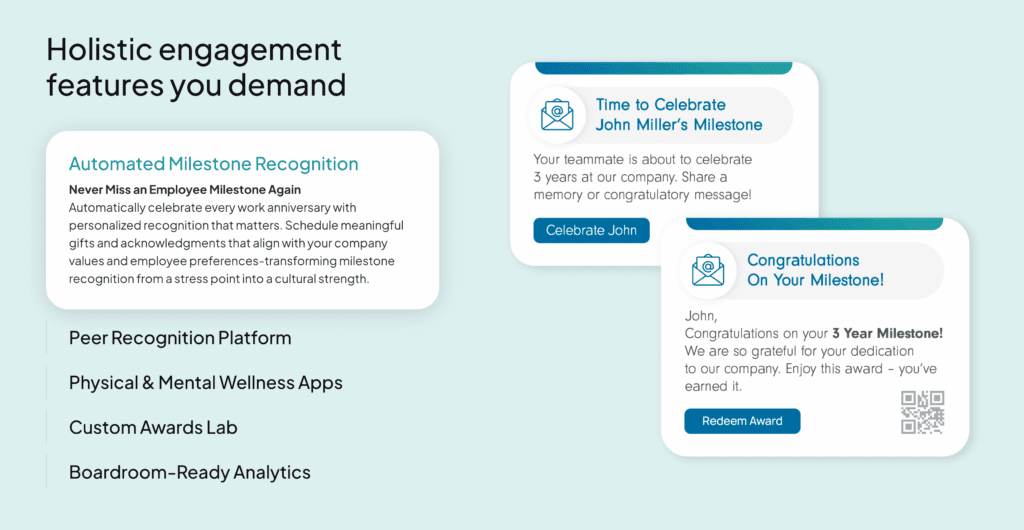
After you’ve identified gaps using survey insights—e.g., low belonging scores in the customer service department—you can take targeted action using Terryberry’s integrated recognition software and wellness solutions.
Terryberry’s engagement indicators are interconnected with Recognition and Wellness at the center, allowing you to measure the impact of these programs on specific indicator scores over time.
With Terryberry, you can:
✅ Launch recognition, milestone, and performance incentive programs tailored to strategic objectives. Celebrate loyalty with a years of service awards program, promote core values with peer recognition, and drive performance objectives like increasing sales or reducing delivery times with tailored programs.
✅ Motivate people with the incentives they’ll love. Terryberry’s rewards platform is integrated with our broader engagement suite, so you can tie points-based reward systems to your recognition and wellness programs. Access the widest selection of rewards in the U.S. market via Terryberry x Amazon Business or design custom shopping portals with Terryberry’s Premium Awards catalog.
✅ Support employees’ physical and mental well-being. With Be Well, you can launch activity and custom wellness challenges and support employees with personalized wellness plans, on-demand well-being content, and expert-led wellness seminars.
✅ Create inclusive experiences. We bring your engagement programs wherever your team works, with desktop and mobile apps, MS Teams and Outlook integrations, passwordless login, and offline rewards redemptions (including via QR codes) and recognition options.
Measure Impact with Advanced, Centralized Analytics
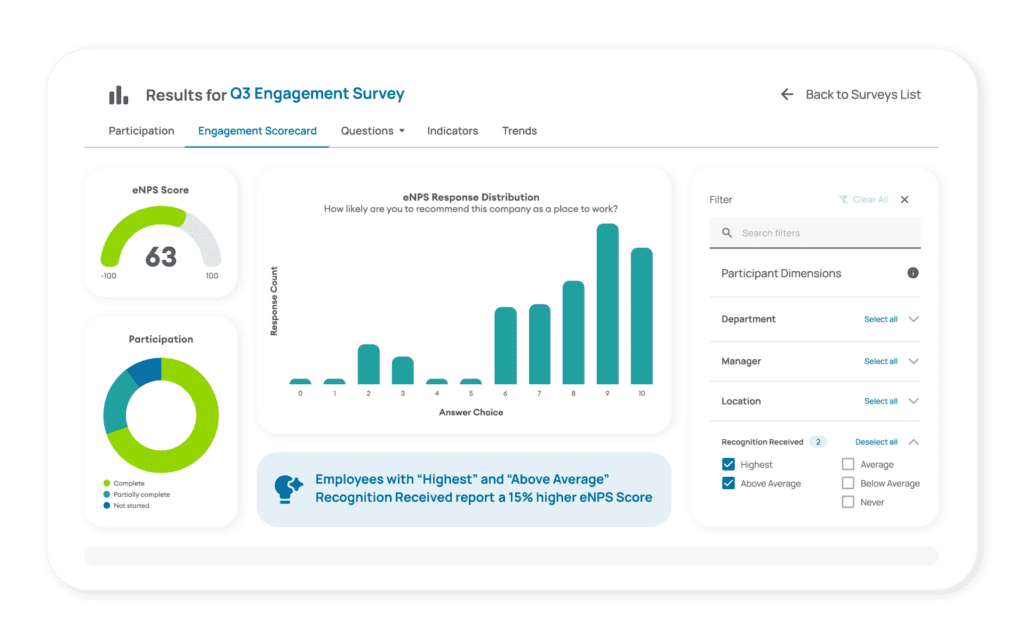
Terryberry combines insights from employee listening with data from your engagement programs, allowing you to track the impact of recognition and wellness on engagement indicators and retention.
For example, let’s say your employee listening program linked high turnover in the customer service department to low belonging and leadership scores.
If you launched manager and peer recognition programs to address these gaps, you can later measure the impact by comparing the eNPS, belonging, and leadership scores of:
- Your most and least recognized employees.
- Employees whose managers give frequent recognition vs. employees whose managers rarely give recognition (or don’t at all).
Terryberry’s centralized analytics dashboard lets you slice and dice data using different views and participant filters, including:
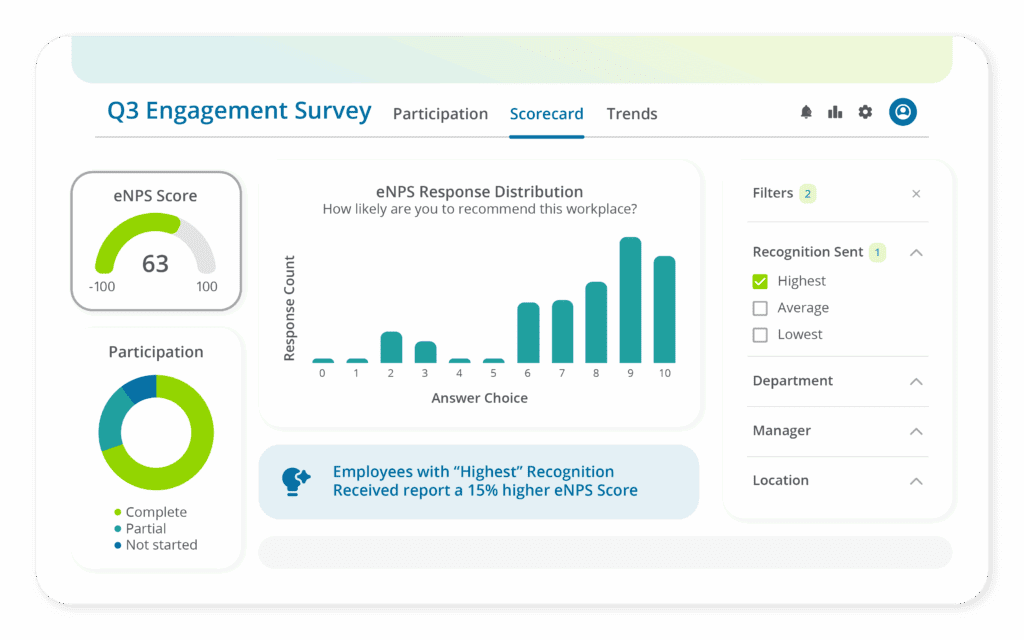
- Engagement Scorecard: View eNPS and retention scores side-by-side with consistent filtering
- Likert view: Individual question scores with heat mapping
- Indicators view: Rollup scores across the 6 engagement indicators
- Recognition filters to compare eNPS scores of highly-recognized vs. under-recognized employees.
These combined insights help you build a business case for your engagement programs and prove ROI with concrete data—e.g., by showing that employees with the 'highest' recognition received report 15% higher eNPS.
Launch a Continuous Employee Listening Program
Continuous employee listening lays the foundation for a resilient and engaged workforce. By moving beyond annual surveys and embracing a continuous feedback loop, organizations can surface issues early, act with precision, and prove the ROI of their engagement strategies.
The most successful programs show employees that their voices lead to meaningful outcomes, whether that’s improved onboarding, stronger leadership support, or a healthier workplace culture.
This is where a dedicated listening platform like Terryberry makes a difference. By unifying listening, recognition, rewards, and wellness tools in one system, you create a self-reinforcing cycle: feedback drives action, action fuels engagement, results highlight gaps and impact, and the cycle drives continuous improvement.
Over time, this cycle compounds into measurable improvements in retention, satisfaction, and performance.
Schedule a demo today to discover how Terryberry can help you transform employee feedback into a strategic advantage—and build a workplace where people feel heard, valued, and motivated to stay.