July 31, 2026


There's something uniquely satisfying about holding a tangible representation of one's achievements. For organizations recognizing employees, physical awards like trophies, medals, and plaques can play a pivotal role.
So why do these awards still hold value in today's fast-paced world? Moreover, what are the advantages and disadvantages of choosing them over their digital counterparts?
Key Takeaways:
-
Physical awards (trophies, plaques, custom medals) provide a concrete, permanent representation of achievement that carries high perceived sentimental value.
-
Displaying an award on a desk or office wall acts as a daily visual reminder of success, boosting long-term pride and job satisfaction.
-
Presenting physical awards during team meetings or events creates high-impact, memorable recognition moments that strengthen company culture.
-
Use frequent digital recognition for day-to-day peer appreciation, while saving physical awards for major milestones, service anniversaries, and top performance honors.
Explore the Guide:
Understanding the Appeal of Physical Awards in Today's World
Physical awards hold a special place in our hearts and on our mantels. These tangible symbols of recognition are cherished for their ability to commemorate achievements in a unique way and research backs up their power. When you receive a trophy, medal, or plaque, you're holding a piece of your success—a physical reminder of your hard work.
Organizations frequently use physical awards to enhance the emotional value of their recognition programs. A sleek trophy or a beautifully crafted plaque can elevate the prestige of any event or ceremony.
The exclusive and tactile nature of these awards resonates deeply: studies show that tangible rewards generate 15% higher boost in employee performance compared to cash equivalents alone, offering a sense of public acknowledgment that is both gratifying and motivating.
Moreover, physical awards serve as lasting symbols of success that inspire others. According to Gallup, 74% of employees who receive frequent, meaningful recognition report feeling more aligned with their company's goals and values.
Employees who receive personalized awards display them proudly, sparking conversations and encouraging peers to strive for similar achievements. These awards are not just about individual recognition; they foster a culture of excellence within organizations.
From employee recognition to corporate milestones, the significance of tangible recognition cannot be overstated. With over 80% of workers reporting higher engagement when regularly recognized, physical awards offer far more than just a piece of metal or glass—they deliver a lasting psychological impact you can touch, see, and draw inspiration from every day.

What are Physical Awards for Employees?
Physical awards are tangible corporate awards presented to individuals or teams to honor outstanding work, long-term dedication, or major organizational achievements. These physical keepsakes provide a permanent, visible reminder of accomplishment that recipients can display in their office, workspace, or home.
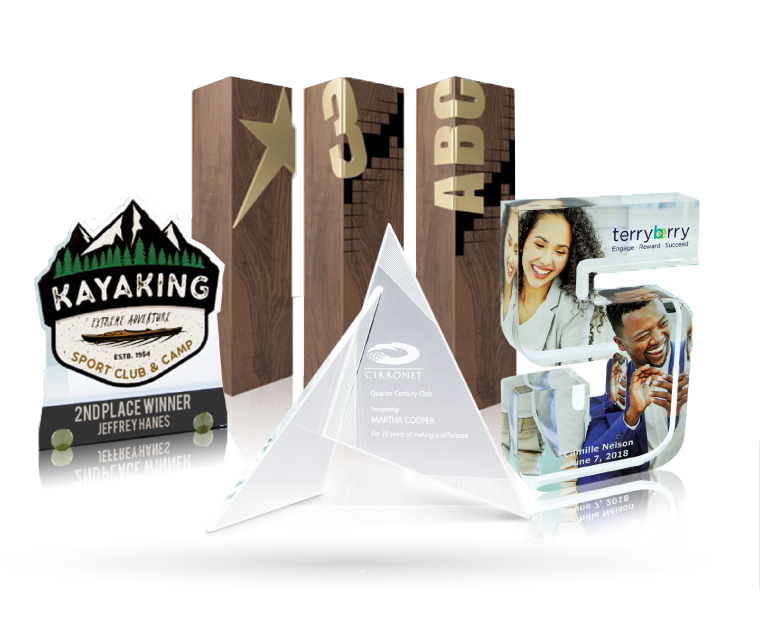
While physical awards come in many styles, five primary types stand out as corporate standards:
Trophies:
The classic symbol of victory. Typically featuring a sculpted figure, cup, or modern geometric design mounted on a base, custom trophies are best suited for top-tier honors, annual performance awards, and competition-based achievements like sales leaderboards.
Acrylic Awards:
Versatile, durable, and shatter-resistant. Acrylic can be molded into virtually any shape, colored, or embedded with graphics, making it ideal for creative designs, company branding, and high-volume employee appreciation events where high visual impact is needed at a manageable price point.
Crystal Awards:
The pinnacle of prestige. Known for their satisfying weight, exceptional clarity, and premium finish, light-refracting crystal awards are reserved for top-tier achievements—such as executive honors, retired board members, lifetime achievement awards, and major corporate milestones.
Plaque Awards:
Timeless and built for wall or desk displays. Crafted from fine wood, metal, or glass, custom plaques offer ample surface area for custom engraving. They are the go-to choice for recognizing years of service, certifications, safety milestones, and team-wide acknowledgments.
Jewelry:
- Custom Lapel Pins & Charms: Versatile, elegant, and timeless. Pins are a staple for service anniversaries, safety milestones, and company values programs. Organizations often use tiered gemstone additions (e.g., adding a diamond or sapphire for every five years of service) to celebrate ongoing tenure.
- Corporate & Championship Rings: Reserved for peak accomplishments—such as top-tier sales performance, executive milestones, or team championship wins. Handcrafted rings customized with company logos, recipient names, and precious metals make an unmistakable statement of prestige.
- Bespoke Watches & Fine Accessories: High-end items like engraved luxury watches, custom tie-tacks, cufflinks, or nursing pins pair daily utility with deep personal sentiment, making them top-choice keepsakes for major retirement celebrations or decade-plus service milestones.
Weighing the Pros and Cons of Physical Awards
Physical awards offer a tangible reminder of achievements that's difficult to replicate, making them uniquely valuable. However, like everything else, they come with their own set of pros and cons. Let's dive into the benefits first.
Pros of Physical Awards
- Permanent Visibility: A cash bonus is usually spent and forgotten within weeks, but a framed certificate, desktop acrylic piece, or commemorative plaque remains on display for years.
- Daily Reinforcement: Every time employees see their award, it acts as a constant physical anchor, reminding them of their competence, hard work, and value to the organization.
- Socially Acceptable Pride: In most workplace cultures, it is considered taboo for employees to talk openly about how much money or bonus pay they made. Awards demonstrate achievement in a more acceptable way.
- Built-in Conversation Starters: Physical symbolic awards act as visual proof of achievement that colleagues, clients, and leaders can compliment naturally, fulfilling the deep psychological need for peer respect without awkwardness.
- Reinforcing Core Values: Symbolic awards allow leaders to reward behavior that isn't easily tied to direct sales metrics—such as mentorship, innovation, teamwork, or embodying company values.
- Building Belonging: Receiving an award signals to the recipient, "You are a vital member of this community". (A famous study on Wikipedia volunteer editors showed that giving simple symbolic awards increased editor retention by 20% simply because it reinforced their identity as part of the community).
- No "Quantity vs. Quality" Trade-off: Controlled field experiments on labor performance found that offering purely symbolic awards (like a congratulatory honors card) increased overall worker performance by ~12% without degrading output quality.
- Intrinsic vs. Extrinsic Motivation: Unlike cash—which can feel like a transactional "bribe" and temporarily crowd out natural enthusiasm—symbolic recognition acts as a genuine, non-transactional "thank you" that boosts intrinsic job satisfaction.
- Unbeatable ROI: Cash bonuses must be sizable to feel meaningful (a $20 cash bonus can feel insulting, whereas a $20 customized symbolic plaque feels thoughtful).
- Separation from Salary: Because symbolic awards sit outside traditional compensation, they aren't evaluated with cold math. Employees assign high emotional value to them regardless of production cost.
Cons of Physical Awards
When a symbolic recognition program isn't set up strategically, there are some common missteps that can occur.
1. The "Zero-Sum" Effect: When awards are competitive or limited to top performers (e.g., "Employee of the Month"), they create a clear distinction between winners and everyone else.
How to fix it: Build recognition into your everyday culture. Peer and social recognition programs, like Terryberry's Be Recognized platform, encourages employees, managers, and senior leadership to recognize each other for daily wins. This helps ensure recognition is accessible for everyone, not just an elite few.

2. Subjective Metrics: If award criteria aren't completely objective, employees often attribute outcomes to favoritism, office politics, or "who is loudest" rather than actual merit.
How to fix it: Build award criteria in line with your company's values. For example, if one of your values is collaboration, create a collaboration-based award. That way, when the person who's always there to help is publicly acknowledged the rest of the team isn't surprised.
3. The "Tokenism" Trap: If a company relies heavily on low-cost awards while underpaying employees or withholding fair raises, symbolic awards feel insulting rather than rewarding.
How to fix it: Recognition isn't built through awards alone. Employees need to have their base needs met before being able to fully embrace and accept symbolic awards. Also be sure that the awards you're presenting are of a quality that's worth being proud of.
4. Generic Execution: Standard, mass-produced certificates with misspelled names or boilerplate text signal to the recipient that management put zero real thought into acknowledging their effort.
How to fix it: Quality is key for symbolic awards. Be sure to find a vendor who you can not only trust for quality, but also one who can advise you on best practices. And always pair a physical award with a genuine, specific verbal or written note detailing how the person made a difference.
Custom Awards: Personalizing Recognition with a Special Touch
In the world of recognition awards, customization is king. Custom awards allow organizations to reflect their brand identity in the design of each trophy, medal, or plaque. By incorporating logos, colors, and unique elements, personalized awards become not just a token of recognition but a representation of the organization's values and ethos.
Personalization options make recipients feel uniquely valued and recognized. Engraving names and achievements adds a personal touch that enhances the award's significance. Whether it's a custom acrylic award with a sleek, modern design or a custom crystal award that sparkles with elegance, the variety of custom award designs available ensures there's something for every occasion.
Organizations can choose from a wide range of materials and designs to suit any event or achievement. From art glass awards that are true pieces of art to classic glass awards that exude timeless elegance, the options are nearly endless. Each choice provides an opportunity to create a memorable and meaningful experience for the recipient.
The role of personalization in awards extends beyond aesthetics. It's about creating a connection between the award and its recipient. When someone receives a personalized award, they know it was crafted with them in mind, making the recognition all the more special.

Get the Perfect Award for Every Occassion with Terryberry
Building a culture of appreciation starts with recognition moments that employees can see, touch, and cherish. That's where Terryberry comes in. Backed by over a century of master craftsmanship, Terryberry helps organizations design custom symbolic awards—from handcrafted jewelry and sleek acrylics to bespoke trophies and commemorative plaques—that reflect your company’s unique values and mission.
Ready to elevate your employee recognition program? Explore Terryberry’s Custom Symbolic Awards today and discover how meaningful recognition can transform your workplace culture.
Frequently Asked Questions